
Written by the Decomica Design Team — updated June 2026. We handle, inspect and quality-assure Eames Lounge Chair reproductions regularly, which means we see — first-hand — what cheap knockoffs get wrong.
An Eames lounge knockoff is not the same thing as a quality reproduction. The word “knockoff” describes something specific: a cheap copy that uses inferior materials, cuts structural corners, and is often sold with misleading descriptions. A quality reproduction uses comparable materials to the original, is built to last, and is sold honestly. The practical difference between the two affects how the chair feels on day one, how it performs after two years, and whether you regret the purchase.
This guide explains exactly what cheap knockoffs get wrong — in the leather, the plywood, the base, the recline mechanism — and how to identify each failure point before you buy.
What Knockoffs Get Wrong: The Four Structural Failures
Most Eames lounge knockoffs fail in the same four places. The failures are predictable because they all stem from the same source: cutting material costs to hit a low retail price. Here is what to look for.
1. Bonded or PU leather instead of genuine aniline leather
This is the most common failure and the most visible over time. Bonded leather is made from reconstituted leather fibres — scraps and dust from hide production — bonded with polyurethane adhesive and pressed onto a fabric backing. It looks like leather in photographs. In use, it does not breathe, it does not develop a patina, and it begins to crack and peel within 18–30 months under regular use. The peeling is distinctive: the surface layer separates from the backing in curling flakes, typically starting at fold lines and edges.
PU leather (polyurethane-coated fabric) is a separate category but fails similarly — it is essentially a plastic surface with no hide content. Some listings describe it as “eco leather” or “vegan leather.” These are not equivalent to leather, and a chair using them should not be priced as if it has leather upholstery.
Genuine aniline leather — what the original and quality reproductions use — is a full hide that has been dyed with soluble dyes without an opaque surface coating. It is warm to the touch, supple, and breathes. It softens and develops character with use. The price of the raw hide alone is a significant cost that cheap knockoffs do not carry.
How to check: Ask for the leather grade in writing. The answer should say full-grain, semi-aniline, or top-grain aniline. “Genuine leather” without grade specification is often bonded. No specification at all is a clear signal.
2. Printed veneer film or thin single-layer veneer shells instead of 7-layer laminated plywood
The plywood shell is the most structurally important component of the Eames Lounge Chair. The original uses multiple thin layers of wood veneer cross-laminated and heat-pressed into a compound curve — a process that produces exceptional rigidity for very little weight. The shells interlock with rubber shock mounts between them, which distribute stress and allow controlled micro-movement.
Knockoffs substitute this with one of two inferior constructions: MDF (medium-density fibreboard) cores faced with a thin printed film that mimics wood grain, or thin single-veneer over MDF. MDF does not have the structural properties of laminated plywood — it is heavy, brittle under impact, and does not flex under load in the same way. It is also significantly more vulnerable to moisture. A cracked MDF shell is not repairable; a delaminated plywood shell sometimes is.
How to check: Ask for the specific shell construction: layer count and whether the veneer is a real wood facing or a printed film. Look at the edge of the shell if you can — laminated plywood layers are visible in cross-section. A uniform edge with no visible layers is MDF with film facing.
3. Hollow or zinc alloy base instead of solid cast aluminium
The five-star swivel base on the original Eames Lounge Chair is die-cast aluminium — a dense, solid material with a deep surface finish that polishes evenly. Knockoffs use zinc alloy (zamak) or chrome-plated steel, either hollow or thin-walled. The differences are:
- Weight: A solid cast-aluminium base makes the chair noticeably heavy. Lift it: a knockoff base feels light by comparison.
- Surface: Chrome plating on steel chips at stress points — mounting holes, arm junctions — within one to two years. Cast aluminium has a deeper, more uniform finish that does not chip in the same way.
- Stability: A hollow or thin-walled base flexes under load. An aluminium base does not.
How to check: Ask whether the base is solid cast aluminium or zinc alloy. Lift the chair. If it feels surprisingly light, the base is not solid aluminium.
4. Incorrect or absent recline mechanism
The Eames Lounge Chair’s recline is not adjustable — the chair sits at a fixed angle between upright and reclining, designed to support the spine in a relaxed-but-not-supine position. This fixed angle was deliberate, not a limitation. Cheap knockoffs sometimes add an adjustable tilt or recliner mechanism, which changes the chair’s posture profile and adds mechanical complexity that is typically the first thing to fail.
The shock mounts between the shells on the original allow subtle flex but not deliberate recline adjustment. Knockoffs that replace this with a recliner mechanism are not reproducing the design — they are producing a different chair with the Eames silhouette.
How to check: A quality reproduction should not advertise a recliner function. The chair should sit at a consistent fixed angle. If the listing promotes adjustable recline as a feature, it is not an accurate reproduction.
The Original: What the Licensed Chair Actually Is
The Eames Lounge Chair was designed by Charles and Ray Eames in 1956 and has been in licensed production ever since — by Herman Miller in North America and Vitra in Europe. A licensed original from either manufacturer currently retails at €5,500–€8,000+ for the chair and ottoman set.
The licensed original uses full-grain leather, multi-layer laminated plywood shells with specific veneer sourcing, and a solid cast-aluminium base. The manufacturing tolerances are tighter than the reproduction market. More significantly, it comes with documented provenance — brand labelling, serial numbering, and a traceable chain of custody. For collectors, that documentation has real value. For daily home use, the functional superiority over a Tier 2 reproduction is real but narrower than the price gap suggests.
Quality Reproduction: The Middle Ground That Makes Sense
A quality reproduction sits between knockoff and licensed original. It uses the same design and comparable materials — genuine aniline leather, laminated plywood shells, solid aluminium base — without the brand provenance or licensed manufacturing. At €600–€1,000 for a full set, it represents a rational choice for buyers who want the design and the material quality but not the collector documentation.
The five failure points above do not apply to a quality reproduction: the leather is genuine aniline, the shells are 7-layer laminated plywood with real veneer, the base is solid cast aluminium, and the recline is fixed at the correct angle. These are the minimum material specifications to look for.
Decomica’s Eames Lounge Chair reproductions meet all five specifications. Full sets from €799 with free EU shipping, 2-year warranty, and 14-day returns.
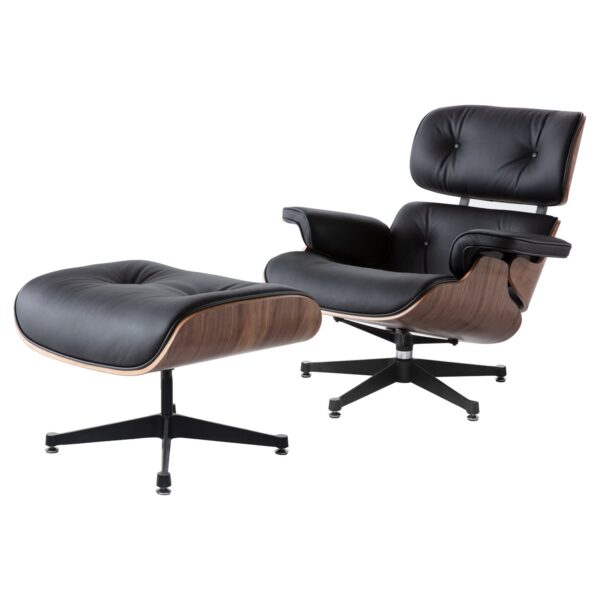
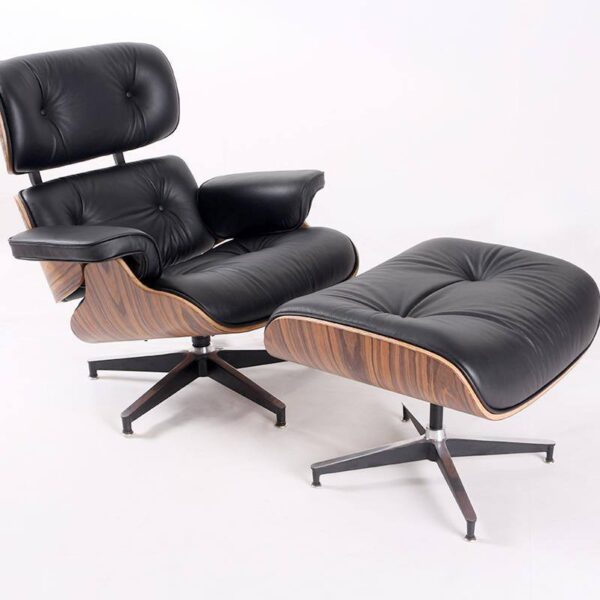
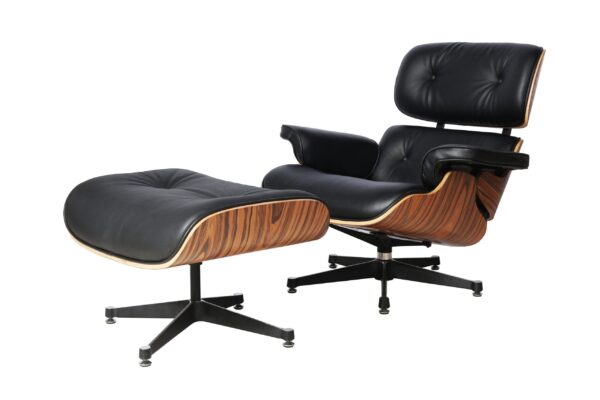
Browse Decomica’s Eames Lounge Chair collection — 34 variants, genuine aniline leather, 7-layer plywood shells, free EU shipping.
Side-by-Side: Knockoff vs Quality Reproduction vs Licensed Original
| Feature | Knockoff | Quality reproduction | Licensed original |
|---|---|---|---|
| Leather | Bonded / PU / “eco” | Genuine aniline | Full-grain aniline |
| Shell | MDF + printed film | 7-layer laminated plywood + real veneer | Multi-layer laminated plywood |
| Base | Zinc alloy / chromed steel | Solid cast aluminium | Die-cast aluminium |
| Recline | Often adjustable (incorrect) | Fixed at correct angle | Fixed at correct angle |
| Cushion attachment | Velcro / adhesive | Button-and-strap | Button-and-strap |
| Expected lifespan | 1–3 years | 10+ years | 20+ years (maintained) |
| Typical price (EU) | €150–€500 | €600–€1,500 | €5,500–€8,000+ |
| Provenance | None | None | Documented |
Frequently Asked Questions
What is an Eames lounge knockoff?
A knockoff is a cheap copy of the Eames Lounge Chair design that uses inferior materials — typically bonded or PU leather, MDF shells with printed veneer film, and a hollow zinc alloy base. It reproduces the silhouette but not the material specification, and fails significantly faster than a quality reproduction or licensed original.
How can I tell if an Eames chair is a knockoff?
Four main signals: the leather is described as bonded, PU, eco, or vegan; the shell construction is not specified or uses MDF; the base is lightweight when lifted; the chair has an adjustable recline function. Any combination of these points to a knockoff rather than a quality reproduction.
Is an Eames lounge knockoff worth buying?
Only if your expectation is a temporary piece with a lifespan of one to three years. At €150–€300 it may represent short-term value. At €400–€500 — where some knockoffs are priced — you are better served by a quality reproduction at €600–€800 that will last a decade or more.
What should I look for in a quality Eames Lounge Chair reproduction instead?
Genuine aniline leather (full-grain or semi-aniline), 7-layer laminated plywood shells with real wood veneer facing, solid cast-aluminium five-star base, fixed recline at the correct angle, and button-and-strap cushion attachment. Ask for each specification in writing before purchasing.
