
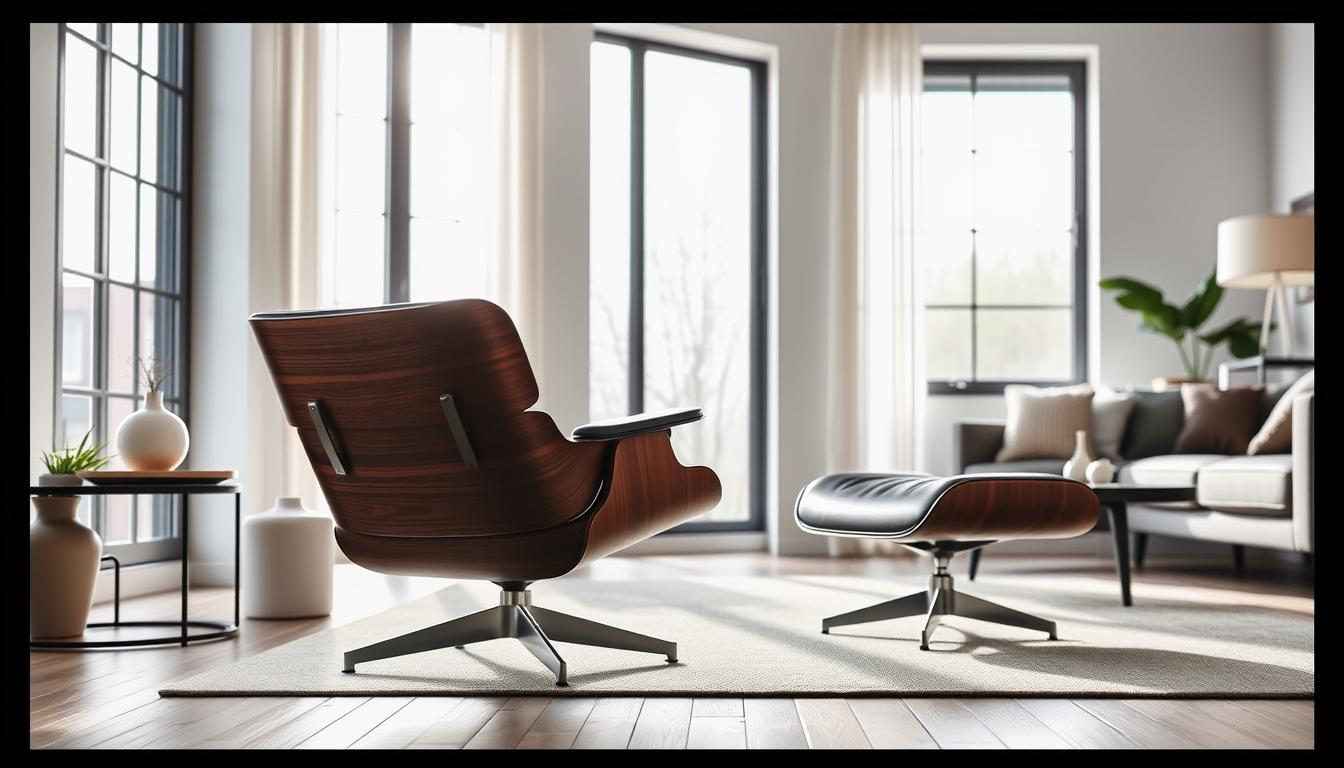
Written by the Decomica Design Team — updated June 2026. We inspect, quality-assure and ship Eames Lounge Chair reproductions across the EU. The checks in this guide come from direct handling experience, not product photography.
The Eames Lounge Chair buying guide that actually helps you is one that tells you what to inspect, not just what to want. Designed by Charles and Ray Eames in 1956, the chair has been reproduced so widely — at every quality level — that the buying decision is almost entirely about knowing what distinguishes a well-built piece from a disappointing one. This guide gives you every check, in sequence, so you can evaluate any chair you are considering — licensed original, quality reproduction, or otherwise.
Step 1: Establish Which Category You Are Buying
Before evaluating any individual chair, be clear about which tier you are shopping in. The three categories are functionally different, not just different in price.
| Category | Who makes it | EU price (2026) | Provenance |
|---|---|---|---|
| Licensed original | Vitra (EU) / Herman Miller (US) | €5,500–€8,000+ | Documented (serial, label) |
| Quality reproduction | Independent manufacturers | €600–€1,500 | None |
| Low-cost knockoff | Various | €150–€500 | None |
If you are buying a licensed original, the primary check is authenticity: genuine Vitra and Herman Miller pieces have manufacturer labels, serial numbers, and come with documentation. If you are buying a reproduction, the primary checks are material specifications. If you are buying from a platform where the category is unclear, establish it before evaluating anything else.
Step 2: Check the Plywood Shell Construction
The shell is the structural heart of the Eames Lounge Chair. A correct shell is multi-layer laminated veneer plywood — thin sheets of real wood veneer, cross-laminated and heat-pressed into a compound curve. The standard for a reproduction that will not delaminate under regular use is seven layers.
What to ask: How many plywood layers does the shell have? Is the veneer facing a real wood facing or a printed film?
What the answer tells you:
- 7-layer laminated plywood with real veneer: correct specification
- 5-layer laminated plywood with real veneer: acceptable, but borderline for long-term load resistance
- MDF core with film facing: this is a knockoff shell, not a laminated plywood shell — avoid
- Supplier cannot specify: treat as MDF until proven otherwise
How to verify in person: Look at the edge of the shell where the layers are visible. Laminated plywood shows distinct alternating layers. A solid MDF edge with a thin surface layer is a different product.
The veneer species matters too: The original used Brazilian rosewood (no longer commercially available) and then walnut. Quality reproductions use genuine walnut or rosewood veneer. A real veneer has visible grain variation; a printed film has a repeating pattern if you look carefully at edges and corners.
Step 3: Verify the Leather Grade
Leather is both the most tactile element of the chair and the component most frequently misrepresented at point of sale. The original uses full-grain aniline leather. Quality reproductions should use genuine aniline leather — full-grain or semi-aniline.
The leather hierarchy:
- Full-grain aniline: The complete hide surface, dyed with soluble dyes, no opaque coating. Breathes, softens with use, develops patina. Most expensive and most durable.
- Semi-aniline: Aniline-dyed with a light protective coating. Slightly more resistant to staining than full-grain. Still a genuine leather product.
- Top-grain (corrected-grain): Surface sanded and coated. Less natural feel; does not develop the same patina. Still genuine leather.
- Bonded leather: Reconstituted leather fibres pressed onto a backing. Looks like leather; peels and cracks within 18–30 months. Not an acceptable specification for a chair in this price category.
- PU / eco / vegan leather: No hide content. Plastic surface. Will not last under regular use.
What to ask: What is the leather grade? Is it aniline? Ask for the specification in writing — a supplier confident in their leather will provide it without hesitation.
How to check in person: Press your thumb firmly into the leather and release. Full-grain and semi-aniline leather will show a slight wrinkle that recovers slowly — this is normal hide behaviour. Bonded leather feels stiffer and does not wrinkle in the same way. Smell matters too: genuine leather has a characteristic organic smell; bonded leather and PU smell synthetic or chemical.
Step 4: Assess the Base
The five-star swivel base should be solid cast aluminium. This is the single most reliable weight and durability indicator in the chair.
Lift the chair. A solid cast-aluminium base makes the complete chair noticeably heavy — typically 30–40 kg for the chair alone. If the chair feels light, the base is not solid aluminium.
Inspect the surface finish. Cast aluminium has a deep, even finish that polishes uniformly. Chrome-plated steel or zinc alloy has a thinner, brighter surface that shows stress at mounting points. Check the junctions between the arms of the base and the central column — this is where chrome plating chips first.
Test the swivel. Rotate the chair through a full 360 degrees. Resistance should be even throughout. Notchy resistance, lateral play at the top of the base, or grinding sounds indicate a substandard bearing assembly.
Step 5: Check the Cushion Attachment and Construction
Cushion attachment is a reliable proxy for overall build attention. On the original and on quality reproductions, cushions attach to the plywood shell via internal button-and-strap fixings — a leather or fabric strap threaded through the cushion and secured to fixing points on the shell interior.
How to check: Turn the seat shell over and look at the underside. You should see fixing points and strap hardware. Adhesive residue or Velcro strips indicate the cushion is glued or stuck — a shortcut that fails faster and is harder to repair.
Foam density matters. The cushions should use high-density foam at minimum 45 kg/m³, wrapped in a down or fibre layer for initial softness. Thin or low-density foam compresses flat within a year of regular use. You can test this by pressing your full hand into the cushion: it should offer clear resistance and recover quickly when you release.
Seam construction. Double-stitched seams on the cushion covers are a reliable quality signal and require genuine leather to execute — bonded leather tears at stitching lines. Single-stitched or glued seams are a cost reduction that shows in wear.
Step 6: Evaluate the Recline Angle
The Eames Lounge Chair sits at a fixed recline angle — not a recliner, not adjustable. The angle positions the occupant between fully upright and fully reclined, supporting the spine in a relaxed posture designed for extended sitting. This fixed angle was deliberate: Charles Eames wanted the chair to always look occupied rather than collapsed.
Any reproduction that advertises adjustable recline or a recliner mechanism is not reproducing the design correctly. The mechanism adds mechanical complexity that is typically the first thing to fail, and changes the ergonomic profile of the chair.
What to look for: The chair should sit at a consistent, fixed angle. The shells should flex very slightly under load (the shock mounts allow this) but should not tilt or recline in a controlled way.
Step 7: Check Dimensions
The Eames Lounge Chair has specific proportions. Significant deviations suggest a different chair using the same visual language rather than an accurate reproduction.
| Dimension | Correct specification |
|---|---|
| Overall width | approx. 84 cm |
| Overall depth | approx. 84 cm |
| Seat height | approx. 37–38 cm |
| Overall height (to headrest) | approx. 83–85 cm |
| Ottoman height | approx. 42 cm |
The low seat height (37–38 cm versus a standard chair’s 45–48 cm) is structural to the design — it produces the reclined feel. A chair with a seat height above 40 cm is not accurately proportioned.
Step 8: Understand What You Are Getting (Configuration Guide)
The Eames Lounge Chair is available in several configurations. Understanding these before buying avoids surprises.
Chair only vs chair and ottoman: The chair is designed to be used with the ottoman. Without it, the low seat height means your legs have nowhere to rest comfortably for extended sitting. Most quality sources sell the set; be wary of chair-only pricing that assumes the ottoman is optional.
Veneer species: Walnut is darker and more contemporary in tone; rosewood is warmer and richer. Both are genuine wood veneers in a quality reproduction. The choice is aesthetic.
Leather colour: Black is the most widely seen configuration and the most forgiving with other furniture. Tan and brown variants work in warmer interiors. White leather is striking but requires more maintenance.
Base configuration: The standard is the elephant base (five-star aluminium). Some reproductions offer alternative base configurations. All should be solid cast aluminium regardless of form.
Where to Buy: Evaluating Sellers
The quality of the piece matters more than the channel, but seller behaviour is a useful signal. A seller confident in their specifications will provide leather grade, shell layer count, and base material in writing without being asked. A seller who deflects these questions or responds with vague terms (“genuine leather,” “premium materials” without specifics) is not a reliable source for a quality reproduction.
Check return policy and warranty: a credible seller of quality reproductions will offer at minimum 14 days return and a 2-year warranty on manufacturing defects. Shorter return windows or warranty exclusions on structural components are indicators of low confidence in the product.
Decomica ships free across the EU, dispatched within 1–2 working days, with 14-day returns and a 2-year manufacturer’s warranty on every piece. All material specifications — leather grade, shell construction, base material — are documented.
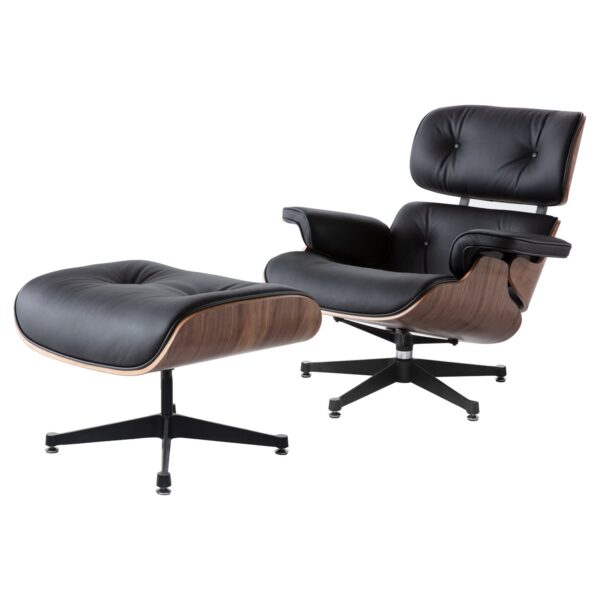
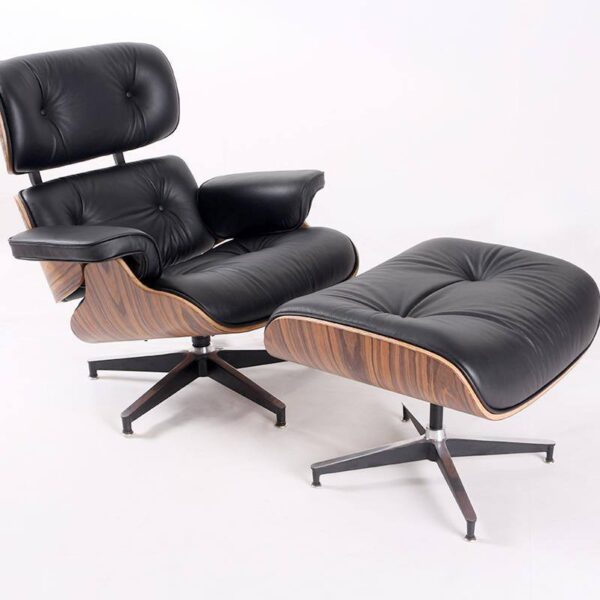
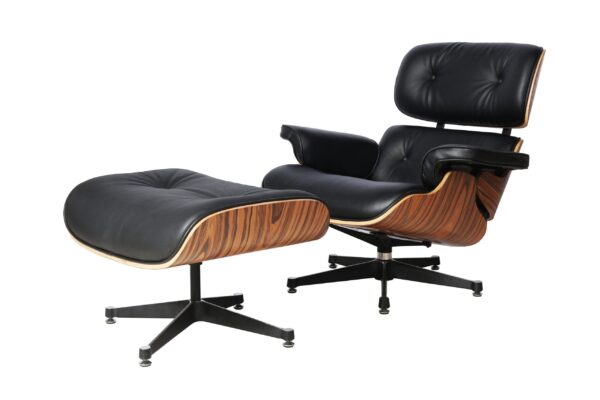
Browse Decomica’s Eames Lounge Chair collection — 34 variants, free EU shipping, all specifications documented.
Frequently Asked Questions
What should I look for when buying an Eames Lounge Chair reproduction?
In order of importance: genuine aniline leather (full-grain or semi-aniline), 7-layer laminated plywood shells with real wood veneer, solid cast-aluminium five-star base, fixed recline at approximately 15 degrees, button-and-strap cushion attachment with high-density foam, and correct dimensions (seat height approximately 37–38 cm).
What size is the Eames Lounge Chair?
The chair is approximately 84 cm wide, 84 cm deep, and 83–85 cm tall to the top of the headrest. Seat height is approximately 37–38 cm — noticeably lower than a standard chair. With ottoman, allow approximately 140 cm of floor depth.
Is the Eames Lounge Chair suitable as an everyday chair?
Yes, for reading, relaxing, and extended lounging — especially with the ottoman. It is not a task chair and is not suitable as a primary desk chair due to the low seat height and fixed recline. For a home reading corner, home office accent, or living room focal point, it performs excellently.
How do I care for an Eames Lounge Chair with aniline leather?
Clean annually with a specialist aniline leather cleaner — not a general leather conditioner, which may over-soften the hide. Avoid sustained direct sunlight, which dries and fades aniline leather over time. For daily care, a dry soft cloth is sufficient. Do not use water, solvent cleaners, or abrasive cloths.
