
Written by the Decomica Design Team — updated June 2026.
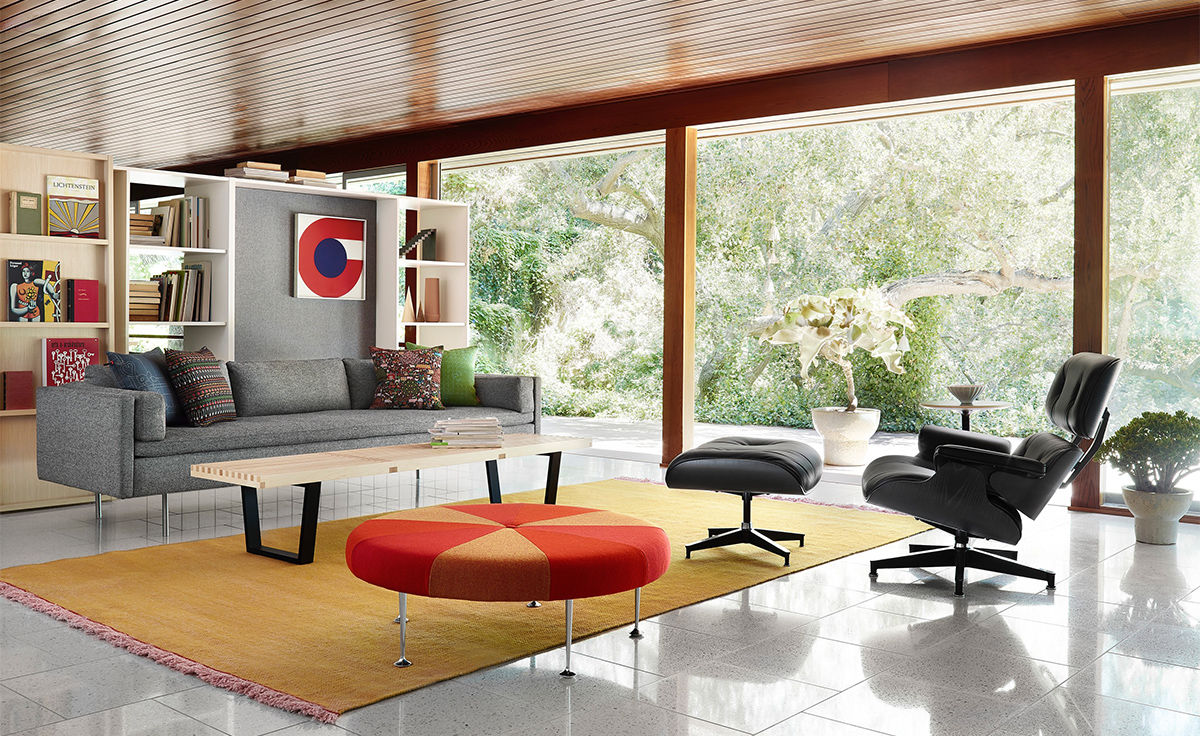
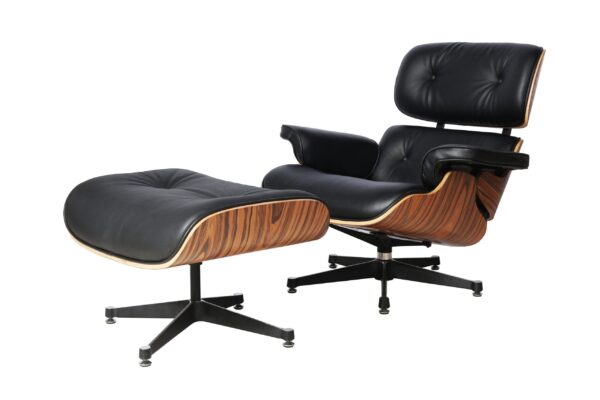
The Eames Lounge Chair is iconic because it solved a genuine design problem — creating a chair as comfortable as a well-worn club chair but as elegant as a piece of sculpture — using materials and manufacturing methods that were genuinely new in 1956. That combination of technical originality, material honesty, and enduring visual balance is why it is still in production, still in museums, and still widely imitated almost 70 years later.
“Iconic” is an overused word in furniture marketing. The Eames Lounge Chair earns it. This article explains the specific, concrete reasons why — from the engineering choices Charles and Ray Eames made in 1955–56 to the cultural moments that cemented the chair’s status, to the reasons a well-made replica carries the same visual authority today.
The Problem Charles and Ray Eames Were Solving
By the mid-1950s, Charles and Ray Eames had spent a decade experimenting with moulded plywood — first for the US Navy (leg splints and stretchers during World War II), then for their early furniture line. They had proved that wood veneer could be moulded into compound curves that were both structurally strong and visually elegant.
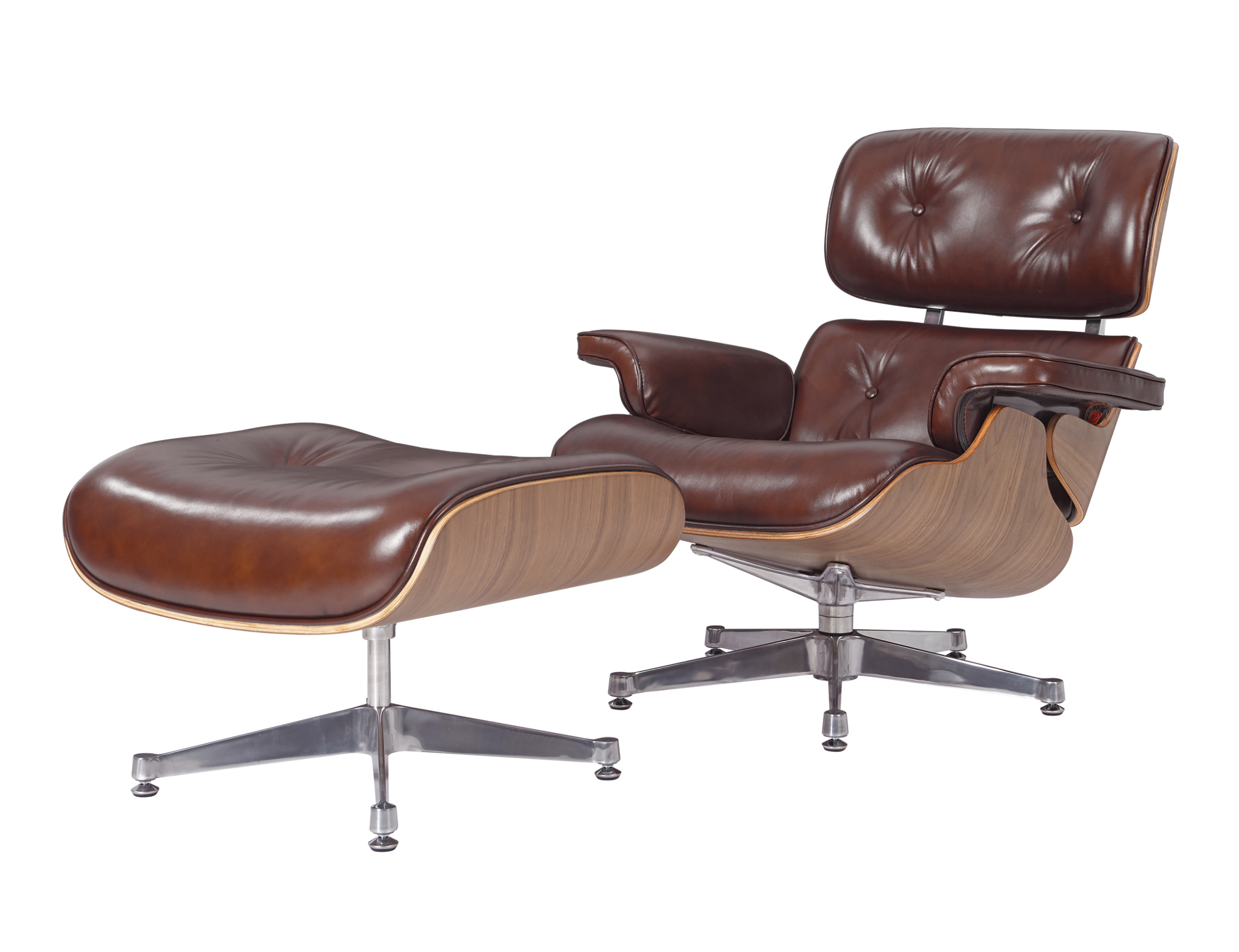
The brief for the Lounge Chair was specific: create a luxurious lounging chair that felt as comfortable as a traditional English club chair — deep, enveloping, made for genuine relaxation — but without the visual heaviness of upholstered club furniture. Charles described the target feeling as “the warm, receptive look of a well-used first baseman’s mitt.” That is an unusually precise design brief, and it explains almost every decision they made.
What Made It Technically New in 1956
Moulded plywood shells at this scale
No chair had previously used moulded plywood shells of this complexity at production scale. Each of the three shell sections (seat, back, headrest) is formed from 7–8 layers of hardwood veneer moulded under heat and pressure into a compound curve. The result is a shell that is simultaneously thin, light, and structurally rigid — strong enough to support a seated adult without the weight of solid wood or the expense of cast metal.
Rubber shock mounts
Each shell attaches to the die-cast aluminium base arms via a rubber shock mount. This was not decorative: the mounts allow each shell to flex micro-dynamically as the sitter shifts weight, absorbing vibration and preventing the rigid-shell creak that plagued earlier plywood furniture. It is an engineering solution borrowed from automotive and aerospace practice. It is also why a well-made Eames Lounge Chair feels alive under you rather than static.
The die-cast aluminium base
The five-star swivelling base was precision die-cast — not fabricated from tube or sheet — giving it the visual crispness and weight distribution that made the chair look equally good from any angle. Combined with a 15-degree recline built into the shell geometry, it produces the chair’s characteristic “open” silhouette: inviting, not imposing.
The Cultural Moments That Solidified Its Status
The NBC debut, 1956
Charles and Ray Eames unveiled the chair on NBC’s Home show in January 1956. The debut was theatrical by design: Charles demonstrated the chair’s comfort on live television, sitting in it and swivelling to face different cameras. For millions of American viewers, the chair arrived as a finished, desirable object before they had ever seen it in a store.
MoMA’s permanent collection
The Museum of Modern Art in New York added the Eames Lounge Chair to its permanent design collection, placing it alongside works by Mies van der Rohe and Marcel Breuer. Museum inclusion signals to the broader culture that an object has moved beyond commerce into cultural heritage. For furniture, few objects reach that threshold.
The television doctor’s chair
For decades, the Eames Lounge Chair appeared as the default set-dressing signal for “intelligent, successful professional” in American television and film. The most famous example is the psychiatrist’s office chair in the TV series Frasier — where it appeared in nearly every episode from 1993 to 2004. That kind of sustained visual association embeds a product in collective cultural memory in a way that advertising cannot buy.
Why the Design Has Not Dated
Most 1950s furniture looks firmly of its time. The Eames Lounge Chair does not. There are several reasons:
- Material honesty: The chair shows what it is made of. The wood is visible wood; the leather is visible leather; the aluminium base does not pretend to be anything else. Designs built on material honesty tend not to date because they are not relying on surface fashion.
- Proportional balance: The three-shell arrangement — seat slightly lower than back, headrest at a slight outward angle — creates a visual rhythm that reads as balanced from any approach angle. This is a function of careful geometry, not taste.
- Functional constraint: Every visible element of the chair does something. There is no applied ornament. Designs of this kind age slowly because there is nothing decorative to become unfashionable.
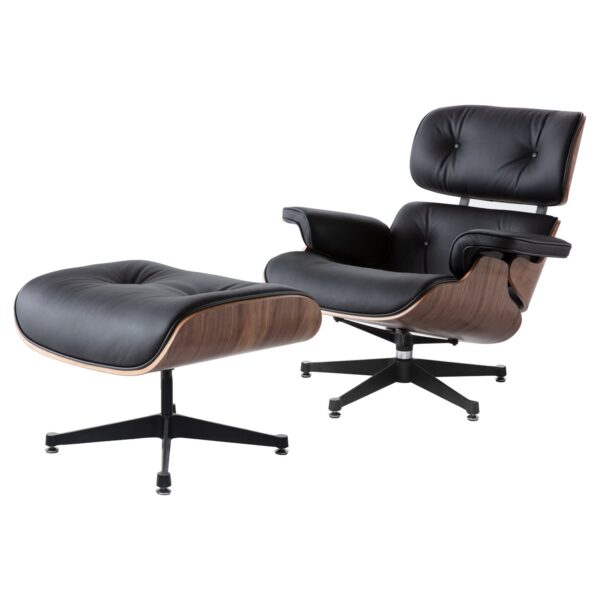
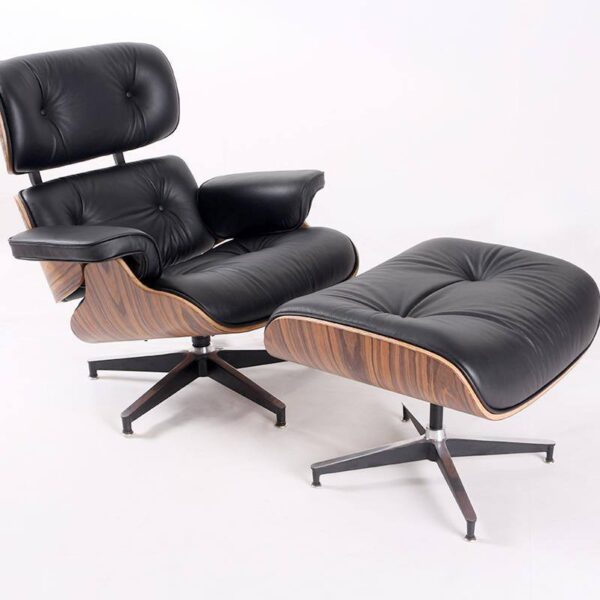
- Colour versatility: Black leather with dark walnut, tan with rosewood, white with ash — the same chair form reads differently in each combination, which is why it works equally well in a 1960s modernist interior and a 2026 Scandinavian-influenced home.
The Iconic Chair in Practice: Dimensions and Specs
| Dimension | Measurement |
|---|---|
| Overall width | 84 cm |
| Overall depth | 85 cm |
| Overall height | 87 cm |
| Seat height | 42 cm |
| Ottoman (W × D × H) | 65 cm × 56 cm × 46 cm |
| Weight (chair + ottoman) | approx. 36 kg |
The chair’s proportions mean it occupies less visual space than its seating comfort suggests. It fits a 3 m × 4 m living room without dominating it — which is part of why it has worked in private homes as well as large public and commercial interiors.
How a Quality Replica Carries the Same Visual Authority
The Eames Lounge Chair’s iconic status is entirely in its form, material choices, and proportions — none of which are protected by active patents. A quality replica built to the same 7-ply shell specification, genuine aniline leather, and die-cast aluminium base carries the same visual weight in a room as the licensed original. The difference is in manufacturing provenance and price: the original is made under Herman Miller or Vitra licence with their quality assurance; a quality replica is made to the same specification without that licence, at a fraction of the cost.
Decomica’s Eames Lounge Chair replica collection is available in over a dozen leather and veneer combinations, with a 2-year manufacturer’s warranty, free EU shipping, and 14-day returns. For a full breakdown of the best replica options by quality tier, see our expert buying guide.
Frequently Asked Questions
Who actually designed the Eames Lounge Chair?
Charles and Ray Eames designed it together, as they designed virtually all of their furniture. Charles Eames was the primary public face of the studio and handled most external communication; Ray Eames was central to the aesthetic and colour decisions. The chair was first produced by Herman Miller in 1956 under a licensing arrangement that remains in place today. Vitra holds the European licence.
Why does the Eames Lounge Chair cost so much in its original form?
A licensed Herman Miller or Vitra Eames Lounge Chair costs €5,000–7,000+ because: (1) it is made in relatively small quantities with US- or German-sourced materials and skilled labour; (2) Herman Miller and Vitra maintain strict quality standards that increase per-unit cost; (3) the brands carry significant design-prestige premiums; (4) authorised dealer networks add distribution margin. The design itself — the geometry, the proportions, the material choices — is not what is expensive. It is the manufacturing provenance and brand premium.
Is the Eames Lounge Chair actually comfortable for everyday use?
Yes, but with a qualification. The chair’s fixed 15-degree recline is excellent for reading, watching television, and relaxed conversation. It is not suited to upright desk work. The leather cushions (down-filled on originals; high-density foam on quality replicas) soften with use. Most owners find it most comfortable after 20–30 minutes of settling. It is not designed as an ergonomic office chair — it is a lounge chair, and it excels at that function.
Does the replica look the same as the original in a room?
Yes, in all important respects. The silhouette, proportions, shell form, and material palette are identical. The differences — manufacturing provenance, cushion fill, leather grade at the very top end — are not visible from across a room or even from normal seating distance. Guests who know the chair well will ask which version it is; guests who simply know it as “the Eames chair” will not be able to tell.
Browse the full Eames Lounge Chair collection — all finishes, full specs, 2-year warranty, and free EU shipping.