
Written by the Decomica Design Team — updated June 2026. This guide consolidates the questions our customers ask most often before buying, plus the honest answers we give them.
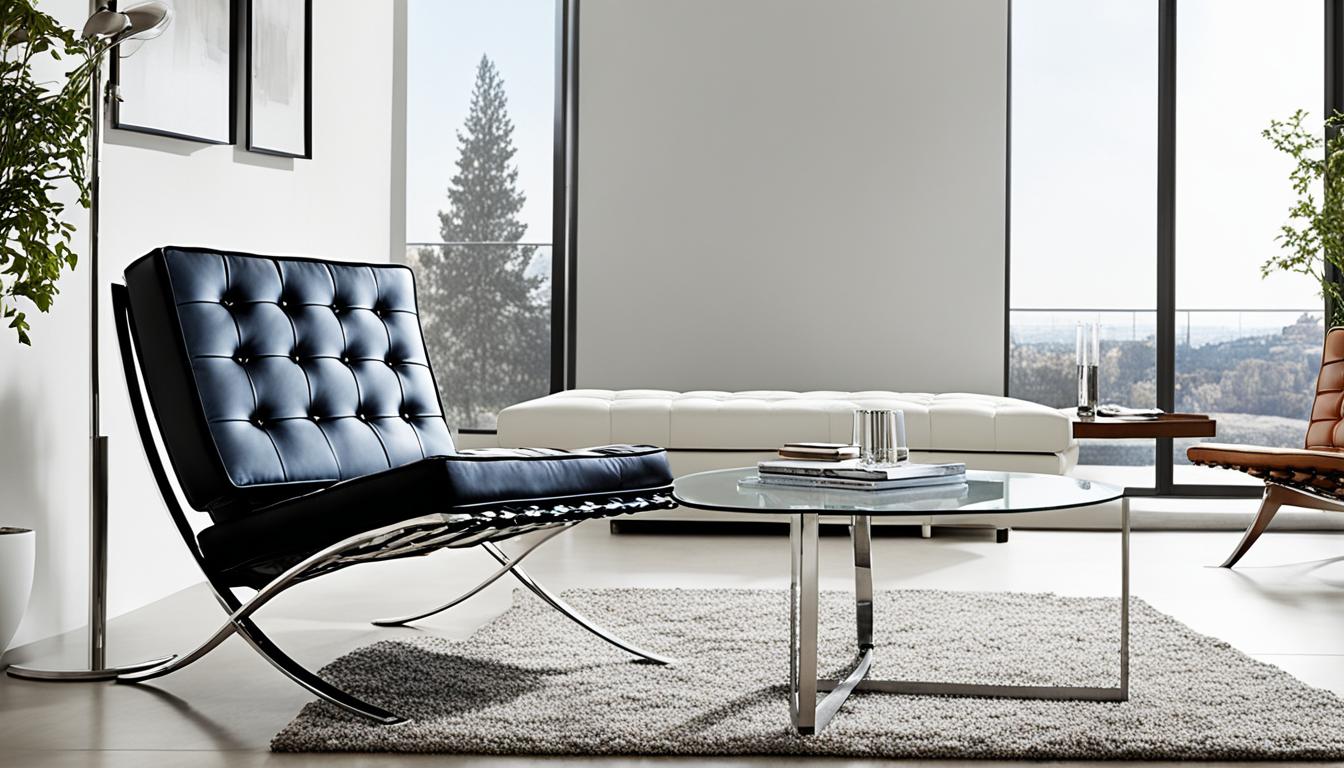
A replica Barcelona Chair gives you the proportions, materials, and presence of Mies van der Rohe’s 1929 design at €400–900 — roughly one-eighth the price of a Knoll-licensed original — provided you choose a version built to the right specification.
The replica Barcelona Chair market is large and varies enormously in quality. The same chair photograph appears on hundreds of product listings at prices ranging from €199 to €899. Some of those chairs are excellent; most are not. This guide explains exactly what to look for, what to avoid, and what you will realistically receive for different price points.
Why the Barcelona Chair Has Been Replicated More Than Almost Any Other Design
Ludwig Mies van der Rohe designed the Barcelona Chair in 1929 for the German Pavilion at the International Exhibition in Barcelona. The commission came with an unusual constraint: the chair had to be fit for royalty. King Alfonso XIII of Spain was to attend the opening, and Mies was not about to seat him in something ordinary.
The resulting design — two crossing flat-bar steel X-frames, floating leather cushions held by leather straps, 40 individual hand-tufted panels — became one of the defining objects of the 20th century. It has been placed in the permanent collections of the Museum of Modern Art in New York and the Neue Nationalgalerie in Berlin. It appears in corporate reception areas, architecture schools, and private homes on every continent.
Knoll has held the licence to produce the original since 1953. The design itself entered the public domain in most European jurisdictions, making it legally possible to manufacture and sell replicas. The consequence is a market that is simultaneously vast and inconsistent.
What a Good Replica Barcelona Chair Must Have
1. Single-Piece Stainless Steel Frame
The original design’s frame is bent from flat-bar stock — a single uninterrupted piece of steel for each X-section. This matters structurally: a welded frame has stress points at the joints that a bent frame does not. It also matters aesthetically: the mirror polish on a solid bar looks different from the mirror polish on a welded joint, which always shows the seam under direct light.
Specify 304-grade stainless steel (also called 18/8 stainless). Avoid chrome-plated mild steel, which looks identical in photographs but corrodes once the plating wears. A practical test: a solid steel frame will weigh considerably more. The complete chair should weigh 35–45 kg. If the seller cannot confirm the weight, ask.
2. Semi-Aniline or Full-Grain Italian Leather
The leather is the first thing you will notice and the first thing that will age. The Barcelona Chair’s cushions are substantial — roughly 5 cm thick on the seat, slightly less on the back — and the leather is under tension because of the tufting. Bonded leather (compressed leather scraps on a backing sheet) cannot sustain that tension for long. It cracks at the tufting points within two to three years.
Semi-aniline leather is full-grain hide that has received a light surface pigment coat. It is more uniform in appearance than untreated aniline leather, more durable, and still breathable. Italian tanneries produce the most consistent supply of this grade. If a seller describes the leather only as “genuine leather” without specifying the grade, assume it is corrected-grain or bonded.
3. Forty Hand-Tufted Cushion Panels
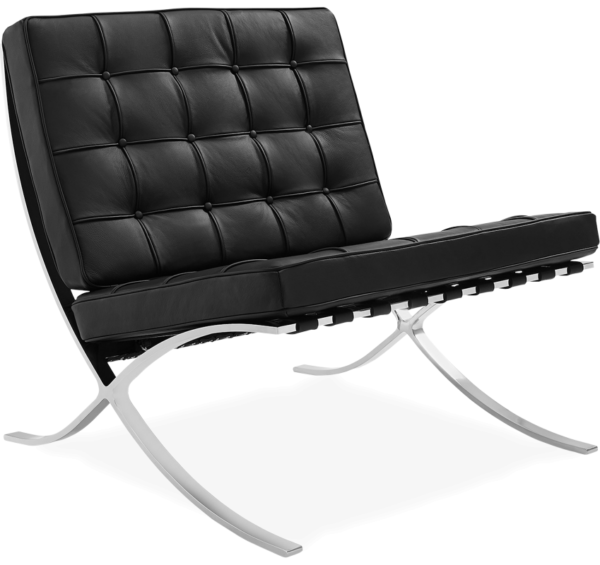
The grid pattern on the seat and back is not decorative stitching. Each of the 40 panels is a separate leather-covered foam section. In a properly constructed replica, each panel is individually stitched and the tufting is pulled through and secured at the back, creating tension that gives the cushion its characteristic tight grid appearance.
In budget versions, the “tufting” is achieved by stitching lines into a single foam slab. This looks similar in photographs but produces a flat result rather than the three-dimensional grid of the original. The panels will not maintain their shape over time.
4. High-Resilience Foam
High-resilience (HR) foam recovers fully after compression. Standard polyurethane foam does not recover fully and will produce a chair that feels progressively flatter with use. HR foam is more expensive, which is why budget replicas use standard foam. There is no reliable way to verify foam grade before purchase; the best signal is price and the seller’s explicit specification.
Replica Price Tiers: What to Expect
| Price range | Likely specification | Expected lifespan |
|---|---|---|
| €150–300 | Chrome-plated mild steel, bonded or PU leather, standard foam | 2–3 years before visible deterioration |
| €300–500 | 304 stainless steel (often hollow), genuine leather, standard foam | 5–8 years with care |
| €500–900 | Solid 304 stainless, semi-aniline Italian leather, HR foam, 40 hand-tufted panels | 10–15+ years |
| €4,000–6,000 | Knoll-licensed original, full provenance documentation | Indefinite (collectible grade) |
The practical buying decision is usually between the €300–500 range and the €500–900 range. The higher tier costs roughly 60% more and lasts roughly twice as long — and, critically, maintains the visual quality that justifies having the chair in the room in the first place. A cracking leather cushion on a €250 chair is not a minor inconvenience; it is the central visible feature of the room.
Colours and Configurations Available
The Barcelona Chair is available in a wide range of leather colours. The most widely available are:
- Black — formal, versatile, the default specification for most commercial interiors
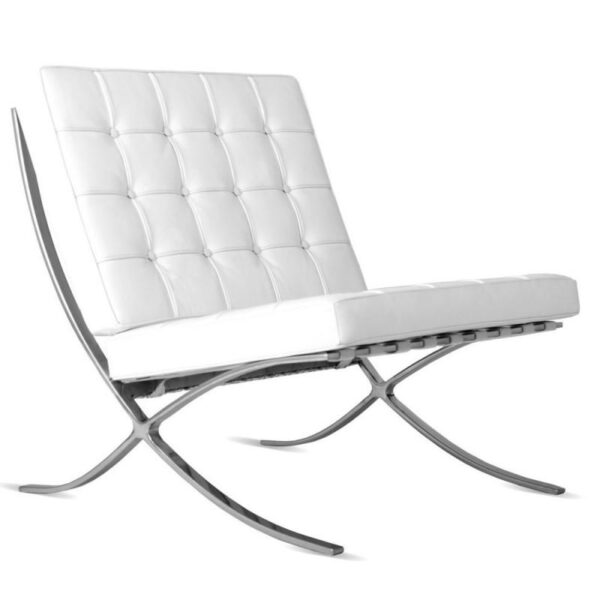
- White / Ivory — lighter residential feel; shows marks more readily and requires more regular conditioning
- Caramel / Tan — warm, residential; ages visibly and attractively with semi-aniline leather
- Dark brown — traditional feel, pairs well with wood-dominant interiors
- Red — accent use; the chair becomes the focal point of the room
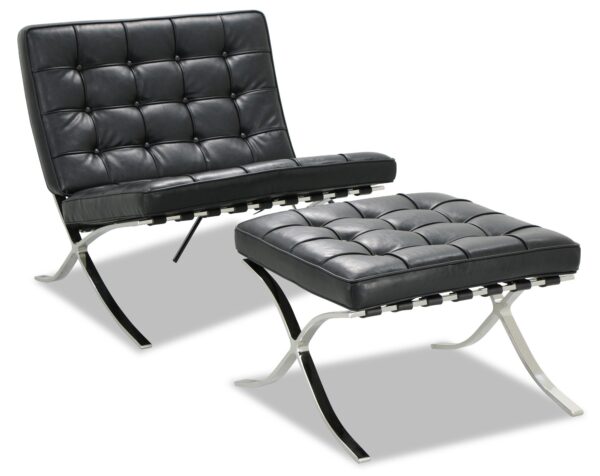
The chair is also available as a chair-only purchase or as a set with the matching Barcelona Ottoman. The ottoman — a low rectangular footstool using the same frame and leather construction — completes the proportional composition Mies originally designed. For lounge and reception areas, the chair-and-ottoman set is the standard specification.
Browse the full range at Decomica’s Barcelona Chair collection.
Assembly and Delivery
A quality replica Barcelona Chair arrives partially assembled. The cushions are attached in the factory; the frame sections typically need to be joined on delivery. Assembly takes 15–20 minutes and requires no specialist tools — the bolts that connect the frame sections are accessed from underneath and tightened with an Allen key.
At Decomica, orders dispatch within 1–2 working days and are delivered by DPD Ireland within 5–7 working days after dispatch. The total order-to-door time is typically 6–9 working days. Delivery is free across the EU. You can track your order at dpd.ie/tracking using the number sent to you by email after dispatch.
For a detailed comparison of available models and their specifications, see the comprehensive review of the best Barcelona Chair replicas for sale.
Frequently Asked Questions
Are replica Barcelona Chairs legal to buy and sell in Europe?
Yes. The Barcelona Chair design has entered the public domain in most European jurisdictions. Replicas are manufactured and sold legally across the EU. The Knoll trademark applies to the Knoll brand name and certain specific markings, not to the chair’s design or proportions.
How do I tell a good replica from a poor one before buying?
Ask four questions: (1) What is the frame material and grade? (304 stainless steel is correct; chrome-plated mild steel is not.) (2) What leather grade is used? (Semi-aniline or full-grain is correct; bonded or PU leather is not.) (3) How many cushion panels are there and are they individually hand-tufted? (40 panels, hand-tufted, is correct.) (4) What does the complete chair weigh? (35–45 kg indicates solid steel; under 20 kg indicates hollow construction.)
What is the difference between a replica and a reproduction?
In practice the terms are used interchangeably. A replica and a reproduction both refer to a chair built to the proportions and specification of the original design without being produced by the licensed manufacturer. Neither term implies inferiority — quality depends entirely on the materials and construction used.
Does Decomica offer trade discounts for architects or interior designers?
Yes. Trade and volume discounts are available on request. Contact support@decomica.com with details of your project and the team will respond within 24–48 hours.