

By the Decomica editorial team — mid-century replica furniture for EU homes and offices
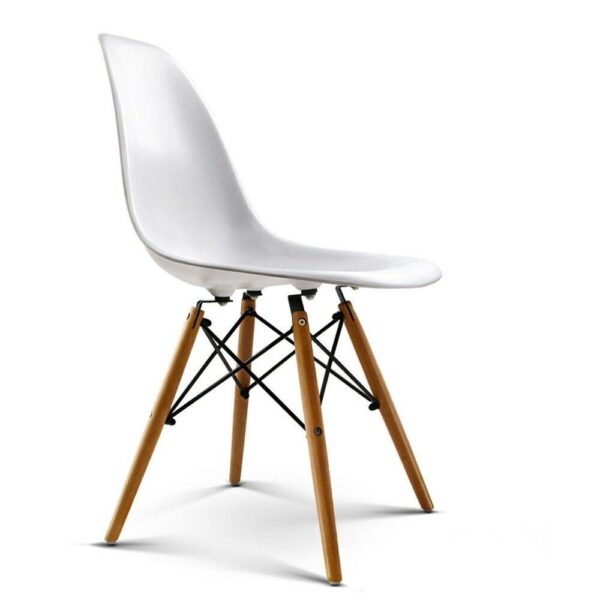
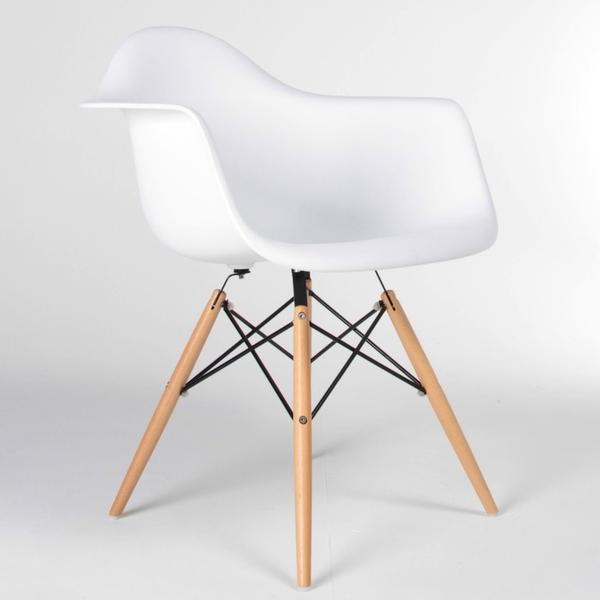
The Eames DAW replica is the armchair configuration of the moulded-shell dining chair family that Charles and Ray Eames developed from 1948 onwards. Where the DSW is a side chair with no armrests, the DAW — Dining Armchair Wood — uses a wider shell with integrated armrests on the same four solid-wood dowel-leg base. If you want the Eames shell-chair silhouette at a dining table but prefer arm support, the DAW is the version to consider.
This article covers the design differences between the DAW and DSW, materials and dimensions, how the white finish specifically performs in real interiors, and what ordering from Decomica looks like from payment to delivery.
DAW vs DSW: What Changes
The two chairs share the same origin: both are part of the shell-chair series that Charles and Ray Eames began developing in 1948, initially for a Museum of Modern Art competition in New York. The production versions launched in 1950 through Herman Miller (US) and Vitra (Europe).
The distinction is in the shell:
| Feature | DSW (Dining Side Wood) | DAW (Dining Armchair Wood) |
|---|---|---|
| Armrests | None | Integrated into shell |
| Overall width | 46 cm | Approximately 62–65 cm |
| Seat height | 43 cm | 43 cm (identical) |
| Leg base | 4 solid-wood dowel legs | 4 solid-wood dowel legs (same base) |
| Table compatibility | Fits 4 around a 120 cm table | Better at table ends; wider footprint |
| Typical use | Standard dining seating | Head-of-table or accent seat; armchair at a desk |
Many households use a DAW at each end of a rectangular table and DSW chairs along the sides. The seat heights are identical, so the visual line of the table is consistent across both chair types.
Construction Details
The Shell
The DAW shell is moulded in a single piece from injection-moulded ABS plastic. The armrests flow from the same continuous curve as the seat back — they are not bolted on but formed as part of the shell itself. This is what makes the design distinctive: the whole form — seat, back, armrests — comes from one mould.
The white ABS finish is a through-colour: the pigment is in the material before moulding, so surface scuffs show as a slightly abraded surface rather than exposing a different colour underneath. White does show marks from hands, particularly greasy fingerprints, more clearly than darker shells. A wipe with a damp cloth handles most marks on ABS.
The Base
The four dowel legs are solid beech on the standard version (solid walnut on premium variants). They attach to the shell through cast metal cups bonded to the shell underside. Two powder-coated steel struts cross beneath the seat for lateral rigidity. The legs arrive unattached and are fitted by the buyer with a supplied allen key — approximately 10 minutes per chair.
Full Specification Table
| Specification | Detail |
|---|---|
| Shell material | Injection-moulded ABS plastic |
| Leg material | Solid beech (standard) / solid walnut (premium) |
| Sub-seat braces | Powder-coated steel |
| Overall height | Approximately 83 cm |
| Seat height | 43 cm |
| Overall width | Approximately 62–65 cm (including armrests) |
| Depth | Approximately 50 cm |
| Assembly | Buyer-attached legs, allen key supplied |
| Colours available | White, black, light grey, red, mustard, light blue and others by batch |
| Warranty | 2-year manufacturer’s warranty |
The White Finish in Practice
White is the best-selling colour for both the DAW and DSW replicas. It performs well in specific contexts and has known trade-offs worth stating plainly:
- Best setting: Rooms with good natural light. White shell chairs read as part of the room’s background rather than as furniture objects, which reduces visual clutter in smaller dining rooms.
- With table materials: White shells work with light timber (ash, birch, light oak), with marble-effect tables, with dark stained timber, and with painted tables. They are neutral enough to accommodate most table finishes.
- Maintenance: ABS cleans easily with a damp cloth. Stubborn marks — food dyes, coffee — may require a mild detergent. Avoid abrasive cleaners, which dull the surface finish.
- Ageing: ABS can yellow slightly under prolonged direct UV exposure. This is not typically an issue in a dining room but may be relevant if the chair will be in a south-facing conservatory with direct summer sun.
Where the DAW Works
Beyond the dining table, the DAW replica works as:
- A desk chair: The armrests make extended desk use more comfortable than the DSW. For occasional home-office work at a standard-height desk (74–76 cm), the 43 cm seat height is appropriate.
- A reading or accent chair: In a living room or bedroom, a white DAW against a darker wall is a clean, considered accent. The shell’s sculptural quality reads as a decorative element when the chair is empty.
- A home office meeting chair: Lighter and easier to move than upholstered chairs. For short meetings the DAW is adequate; for all-day desk work, additional lumbar support may be needed.
The full range of DAW and DSW variants is available in the Decomica dining chair collection.
Ordering, Shipping and Returns
Decomica ships free throughout the EU, plus Norway and Switzerland. All prices are VAT-inclusive with nothing extra charged on delivery. Free shipping does not apply to Bulgaria, Greece, Malta, or Cyprus, where a delivery supplement applies.
Orders are dispatched within 1–2 working days. EU delivery takes 5–7 working days from dispatch (total 6–9 working days door to door). DPD provides all deliveries and sends a tracking link by email after dispatch.
Payment is accepted by credit or debit card, or PayPal. Klarna is not available. B2B customers requiring a VAT-exempt invoice can request one via support@decomica.com.
Returns: 14-day window from receipt. Manufacturing defects or transit damage are handled with a free Decomica-arranged DPD collection. Change-of-mind returns require the customer to cover the DPD pickup cost of approximately €40–50. The item must be in original packaging. Refunds are processed within 30 days of Decomica receiving the returned item.
A Matching Product
Frequently Asked Questions
What does DAW stand for?
Dining Armchair Wood. D = dining height; A = armchair (with armrests); W = wood base. The DSW equivalent replaces the A with S for Side chair (no armrests).
Is the DAW comfortable for extended sitting?
The moulded shell is comfortable for dining durations — typically 30–60 minutes. For extended desk work, the DAW provides better arm support than the DSW, but neither chair is designed as an all-day work seat. The lumbar curve is subtle rather than pronounced.
Can I mix DAW and DSW at the same dining table?
Yes. The seat heights are identical (43 cm), so both chairs sit at the same level relative to the table. A common arrangement is one DAW at each end of a rectangular table and two or four DSW chairs along the sides.
How does the DAW replica compare to a Vitra DAW?
A Vitra DAW retails at approximately €450–550 new from an authorised dealer. The Decomica replica is a fraction of that price. The Vitra uses fibreglass-reinforced polypropylene with a distinctive surface texture. The Decomica uses ABS, which is visually similar but feels subtly different close up. The Vitra carries licensed provenance and higher resale value; the Decomica is sold openly as a reproduction.
Does Decomica sell DAW chairs in sets?
DAW variants are listed individually on the site. For purchasing larger quantities, contact support@decomica.com for trade pricing.
What colours are available for the DAW replica?
White, black, light grey, red, mustard, and light blue are standard. Availability of other colours varies by batch. Check the current product listings for live stock.
Is there a physical Decomica store?
No. Decomica is online-only. Pre-purchase questions are handled via live chat or support@decomica.com. Responses are typically within 24–48 hours, Central European Time.
